Watering a Newly Planted Garden: Protecting the Investment Below the Surface


A newly planted garden can look complete remarkably quickly. Trees are positioned, borders are filled, grasses begin to move through the planting and the structure of the design finally becomes visible.
But beneath the surface, the garden is still very much under construction.
Every newly planted tree, shrub, perennial and hedge must establish a functioning root system within its new soil before it can properly support the growth we see above ground. During this establishment period, water is one of the most important factors determining whether a planting scheme simply survives or develops into the healthy, resilient landscape it was designed to become.
A carefully considered planting scheme is an investment. Watering should therefore be treated as part of the design and establishment process rather than an occasional maintenance task.
Why New Planting Needs Particular Attention

A plant arriving from a nursery has been growing within a defined rootball or container. Once planted, those roots need time to move beyond that original root system and establish themselves within the surrounding soil.
Until this happens, the plant has access to a surprisingly limited reservoir of moisture.
This is particularly important with larger trees and shrubs. A substantial canopy may be losing moisture through hundreds or thousands of leaves while the root system responsible for replacing that water remains relatively compact.
This is why a garden can appear damp after rain while a newly planted tree is still experiencing drought below the surface.
The RHS identifies insufficient watering during the establishment period as one of the principal causes of newly planted trees and shrubs failing to establish successfully.
Water Thoroughly From the Beginning
Every plant should be thoroughly watered immediately after planting.
This first watering does more than provide moisture. It helps settle the soil around the rootball and removes larger air pockets, creating good contact between the existing roots and their new growing environment.
After this initial watering, the aim is not to keep the upper few centimetres of soil permanently wet.
Instead, we want moisture to travel deeply into the root zone.
Frequent light watering encourages roots to remain close to the surface. Slow, thorough watering encourages them to explore deeper soil, helping to create a stronger and ultimately more drought-resilient plant.
For established borders this principle remains valuable, but it is particularly important during the first growing season.
How Much Water Does a New Garden Need?

There is no single litre figure that can sensibly be applied to every garden.
A sandy soil may drain rapidly. Heavy clay can remain wet for considerably longer.
Large specimen trees require substantially more water than small herbaceous plants, while a south-facing border beside a stone wall may dry much faster than seemingly identical planting elsewhere in the garden.
Weather matters too. Wind can be particularly dehydrating because moisture is being lost from foliage even when temperatures do not feel especially high.
As a useful reference, the RHS suggests that newly planted trees and shrubs may typically require around 30–50 litres of water per square metre each week during dry weather in the growing season, while an individual newly planted tree may need roughly four to six full 10-litre watering cans per week depending on conditions.
These figures are a guide rather than a prescription.
The most reliable test is the soil itself.
Push a trowel carefully into the soil beside the rootball and inspect the moisture below the surface. The aim is for moisture to have penetrated through the root zone rather than merely darkening the topsoil.
For young trees and shrubs, the soil should be moist approximately 20–30cm below the surface; for newly planted herbaceous perennials, around 15cm is generally the relevant root depth.
How Often Should Newly Planted Gardens Be Watered?
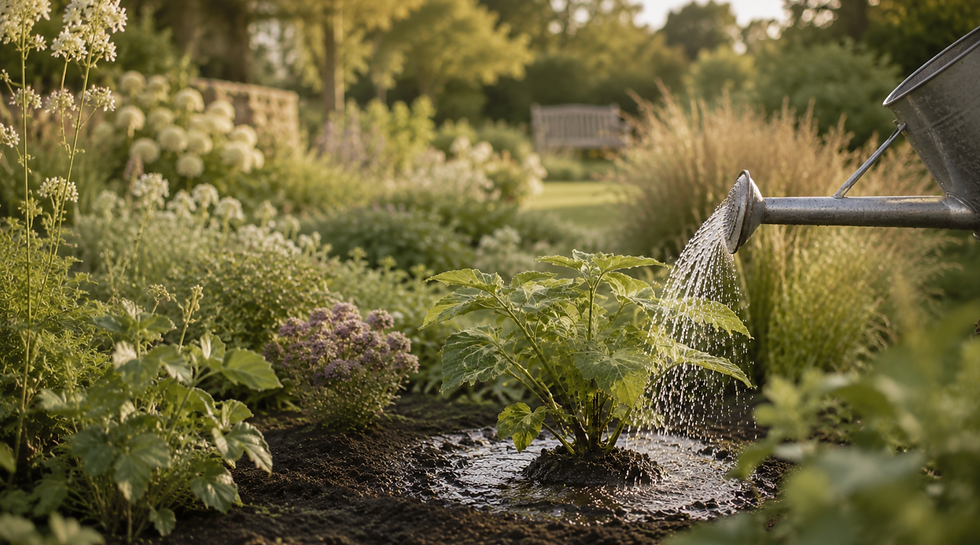
Rather than programming yourself to water every day regardless of conditions, establish a habit of checking regularly and watering thoroughly when required.
Immediately after planting, check the garden frequently, particularly during warm, sunny or windy weather. New planting carried out during spring or summer demands considerably more vigilance than planting undertaken during cooler autumn conditions.
As roots establish, watering can gradually become less frequent but deeper.
A sensible pattern is:
Immediately after planting: thoroughly soak the complete root zone.
During the first few weeks: check soil moisture daily during dry or warm weather. Water when the root zone is beginning to dry rather than automatically adding water to already wet ground.
During the first growing season: continue checking at least once or twice each week during dry periods and give substantial, deep waterings when required.
Larger specimen trees: continue monitoring beyond the first year. Large trees can require supplementary watering for two or three summers while their root systems establish.
Plants described as drought tolerant are not exempt. Drought tolerance develops once the root system has become established; it does not mean that a newly planted specimen can immediately survive without water.
The Best Time of Day to Water
Early morning is generally the ideal time.
Temperatures are cooler, evaporation is relatively low and the plant has moisture available as conditions warm throughout the day.
Evening is the second-best option, particularly during very hot weather, although repeatedly wetting foliage late in the day can leave leaves damp overnight and may encourage fungal problems.
The least efficient time is the middle of a hot, sunny day, when water can be lost rapidly through evaporation before it reaches the depth where it is required.
There is another advantage to morning irrigation: paths, terraces and foliage have an opportunity to dry as the day progresses.
Water the Roots — Not the Plant

One of the simplest watering mistakes is concentrating on the visible plant rather than the invisible root system.
The water belongs on the soil.
Direct water slowly around the rootball and immediate root zone rather than spraying the foliage.
With a newly planted tree, concentrate initially on the area occupied by the rootball, gradually extending the watering area as roots establish into the surrounding ground. Avoid repeatedly directing a powerful stream against the trunk or crown.
Shrubs and herbaceous plants should similarly be watered around their bases.
Applying water directly to the root zone is more efficient, reduces unnecessary evaporation and helps avoid creating permanently wet foliage.
Mulching the soil after planting can make an enormous difference too. A suitable organic mulch reduces evaporation, moderates soil temperature and suppresses weeds that would otherwise compete with new planting for moisture.
Keep mulch away from direct contact with trunks and plant crowns.
Can Watering in Sunshine Burn Leaves?

Leaf scorch is often blamed entirely on water droplets sitting on foliage in sunlight.
In reality, scorching on newly planted gardens is frequently a symptom of a broader water imbalance: the leaves are losing water faster than the roots can replace it.
Hot sun, drying winds, insufficient soil moisture and an immature root system can all produce brown or crispy leaf margins.
Water droplets on susceptible foliage in strong sunlight may occasionally contribute to localised marking or scorching, which is another reason why root-zone watering is preferable. But when an entire newly planted shrub or tree begins developing brown edges, curling leaves or premature leaf fall, investigate the moisture around the roots rather than assuming that the leaves themselves have simply been “burnt”.
Hard Water, Limescale and Water Quality

Water quality is another consideration, particularly in areas with hard mains water.
Hard water contains higher concentrations of dissolved minerals. Over time these can leave familiar pale limescale deposits on surfaces and irrigation components.
For most garden planting, mains water remains perfectly usable. However, particular attention should be given to acid-loving or ericaceous plants, including plants such as rhododendrons, azaleas, camellias and some heathers.
Repeated watering with alkaline hard water can gradually raise the pH around their roots and affect the availability of nutrients. Rainwater is therefore preferable for these plants wherever practical.
Harvested rainwater can be an extremely useful part of a garden's water strategy, particularly where roof areas allow meaningful volumes to be captured and stored.
One important distinction: water from a domestic water softener should not be used for garden plants, as the salts introduced during softening can be damaging.
Where hard water is used through a permanent irrigation system, filtration, appropriate emitter selection and periodic maintenance should be considered to reduce problems with deposits in small nozzles and drippers.
What Does Under Watering Look Like?

Plants communicate water stress remarkably quickly once you know what to look for.
Typical signs include:
Leaves losing their usual shine or appearing dull and lifeless
Wilting or drooping, particularly in the morning
Curling leaves
Brown or crispy leaf margins
Premature leaf fall
Reduced or stalled new growth
Flower buds dropping before opening
Dieback at the extremities of shoots
The important point is to investigate below the surface.
A border may look damp after a brief shower while the soil surrounding the rootball remains dry. Equally, plants growing underneath established trees, alongside walls or beneath roof overhangs can sit within surprisingly pronounced rain shadows.
And What Does Overwatering Look Like?

More water is not always safer.
Roots require oxygen as well as moisture. If soil remains permanently saturated, water fills the air spaces within the soil and roots can begin to deteriorate.
Symptoms can confusingly resemble drought stress:
Yellowing leaves
Wilting despite visibly wet soil
Soft or declining growth
Leaf drop
Lack of vigour
Root or crown rot
Persistently wet, sour-smelling soil
This is particularly relevant on heavy clay or poorly drained sites — and with automatic irrigation systems where the timer continues running regardless of rainfall.
Before adding more water to a struggling plant, check the soil beside the rootball. Both too little and too much water can produce apparently similar symptoms.


