Exploring the Cellular Architecture: Foundations of Plant Biology

Updated: Aug 12
Plants form the backbone of life on Earth, supporting ecosystems and human societies alike. To truly understand how plants grow, survive, and interact with their environment, we must explore their cellular architecture. The structure of plant cells reveals the foundation of plant biology, explaining how plants perform essential functions such as photosynthesis, nutrient transport, and growth. This post offers a detailed overview of the cellular components that make plants unique and highlights their roles in plant life.
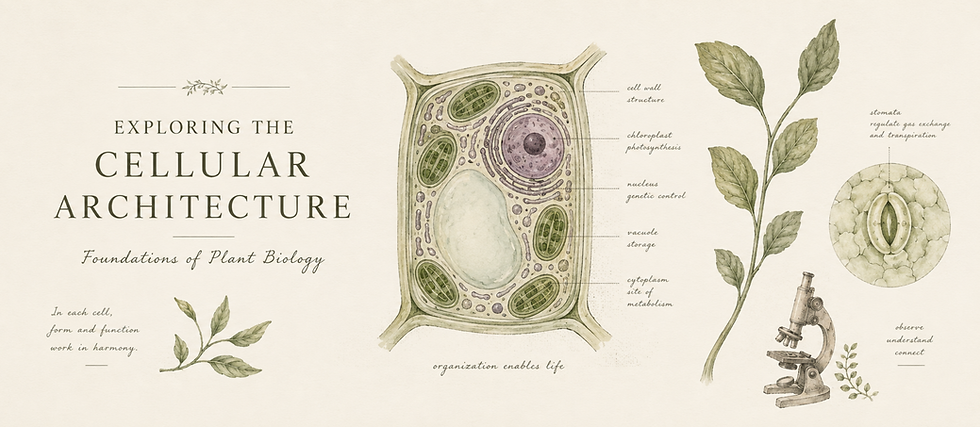
The Architectural Foundations of Plant Biology: An Overview of Cellular Structure
The plant cell serves as the fundamental unit of life within the botanical kingdom. Every structural component of a plant, from its deep-reaching roots to its vibrant, photosynthesising leaves, is composed of these intricate, highly specialised microscopic units. By examining the sophisticated architecture of the plant cell, we gain a deeper appreciation for the complex physiological systems that sustain plant life and, by extension, the broader global ecosystem.
The Cellular Blueprint
At the outermost boundary of the plant cell lies the cell wall, a defining characteristic that distinguishes plants from their animal counterparts. This robust exterior is composed primarily of cellulose, a complex, fibrous carbohydrate that serves as a rigid structural scaffold. This material provides the necessary framework for the plant, granting it the mechanical strength required to grow vertically against gravitational forces and withstand diverse environmental stressors.
Immediately inside the cell wall is the plasma membrane, which regulates the passage of materials into and out of the cell. Within this boundary lies the cytoplasm—a viscous, jelly-like matrix hosting a variety of specialised organelles. Central to cellular governance is the nucleus, which houses the organism's genetic information (DNA). The nucleus acts as the command center, providing the essential instructions for cellular repair, growth, and reproduction.
Energy and Stability
Perhaps the most remarkable organelles found within the plant cell are the chloroplasts. The primary function of chloroplasts is to facilitate photosynthesis: the vital biological process by which plants convert light energy into stable chemical energy. These organelles contain chlorophyll, a specialised pigment that captures solar radiation to synthesise glucose from water and carbon dioxide. This process is the cornerstone of plant metabolism and serves as the primary energy source for the organism, while simultaneously releasing oxygen as a byproduct—a component indispensable for sustaining aerobic life on Earth.
In addition to energy production, the plant cell is distinguished by its large central vacuole. This organelle is critical for maintaining turgor pressure; by regulating the water content within the cell, it ensures that the plant remains firm and structurally sound rather than wilting.
Through the synergy of these components—the rigid cellulose wall, the energy-harvesting chloroplasts, and the fluid-filled vacuole—the plant cell achieves an elegant balance between structural stability and metabolic efficiency. Understanding these fundamental structures provides not only a glimpse into the mechanics of botanical life but also a foundational perspective on the biological processes that underpin the health of our planet.
The Plant Cell Wall: A Protective and Supportive Barrier
One of the most distinctive features of plant cells is the cell wall. Unlike animal cells, plant cells have a rigid outer layer made primarily of cellulose, a complex carbohydrate. This wall provides structural support, allowing plants to maintain their shape and grow upright.
The cell wall protects against physical damage and pathogens.
It regulates water intake through its porous structure.
It enables communication between cells via plasmodesmata, tiny channels that connect neighboring cells.
The cell wall’s strength is crucial for plants to withstand environmental stresses such as wind and drought. It also plays a role in growth by loosening and expanding as cells enlarge.
Chloroplasts: The Powerhouses of Photosynthesis
Chloroplasts are specialized organelles where photosynthesis takes place. They contain chlorophyll, the green pigment that captures sunlight and converts it into chemical energy.
Chloroplasts have a double membrane and internal stacks called thylakoids.
Photosynthesis converts carbon dioxide and water into glucose and oxygen.
This process fuels plant growth and produces oxygen essential for other life forms.
Chloroplasts also have their own DNA, suggesting they evolved from ancient symbiotic bacteria. Their presence is a defining feature of plant cells and some algae.
The Central Vacuole: Storage and Structural Support
Most mature plant cells contain a large central vacuole, a fluid-filled sac that can occupy up to 90% of the cell’s volume.
It stores water, nutrients, and waste products.
The vacuole maintains turgor pressure, which keeps the plant rigid.
It helps in detoxifying harmful substances and breaking down cellular waste.
When plants lack sufficient water, the vacuole shrinks, causing wilting. This highlights the vacuole’s role in plant hydration and overall health.
The Nucleus: Command Center of the Cell
The nucleus controls cell activities by housing the plant’s genetic material (DNA).
It directs protein synthesis and cell division.
The nuclear envelope separates DNA from the cytoplasm.
Inside, the nucleolus produces ribosomes essential for protein assembly.
The nucleus ensures that cells function properly and respond to environmental signals, supporting growth and adaptation.
Cytoplasm and Organelles: The Cellular Workbench
The cytoplasm is a gel-like substance filling the cell, where many organelles float and carry out vital functions.
Mitochondria generate energy through respiration.
The endoplasmic reticulum (ER) synthesizes proteins and lipids.
Golgi apparatus modifies and packages molecules for transport.
Ribosomes assemble proteins from amino acids.
Together, these components coordinate to maintain cell metabolism, growth, and repair.
Plasmodesmata: Channels for Intercellular Communication
Plant cells communicate through plasmodesmata, microscopic channels that cross the cell walls.
They allow the exchange of nutrients, signaling molecules, and genetic information.
This connectivity supports coordinated responses to environmental changes.
Plasmodesmata enable the formation of tissues and organs by linking cells.
This network is essential for plant development and defense mechanisms.
Specialized Cells and Their Structures
Plants contain various specialized cells adapted for specific functions:
Xylem cells have thickened walls to transport water from roots to leaves.
Phloem cells transport sugars and nutrients throughout the plant.
Guard cells regulate gas exchange by opening and closing stomata.
Parenchyma cells perform photosynthesis and store nutrients.
Each cell type has unique structural features that support its role in the plant’s life cycle.
How Cellular Architecture Supports Plant Functions
The unique combination of cellular structures enables plants to:
Capture sunlight and convert it into energy.
Absorb and transport water and nutrients efficiently.
Grow and repair tissues.
Respond to environmental stresses such as drought, pathogens, and temperature changes.
Understanding these cellular foundations helps researchers develop better agricultural practices, improve crop resilience, and explore plant-based solutions for sustainability.

The cellular architecture of plants reveals the intricate design behind their survival and growth. From the protective cell wall to the energy-producing chloroplasts, each component plays a vital role. Exploring these structures deepens our appreciation of plant biology and opens doors to innovations in agriculture and environmental science. To further your knowledge, consider examining how these cellular features vary among different plant species or how they adapt to extreme environments.


